Notification
حظر استيراد كافة أنواع الطيور الحية الداجنة والبرية وطيور الزينة وبيض التفقيس والصيصان عمر يوم ومخلفاتها الغير معاملة حراريا من تركيا ولحين استقرار الوضع الصحي

Ramallah: November 17, 2026
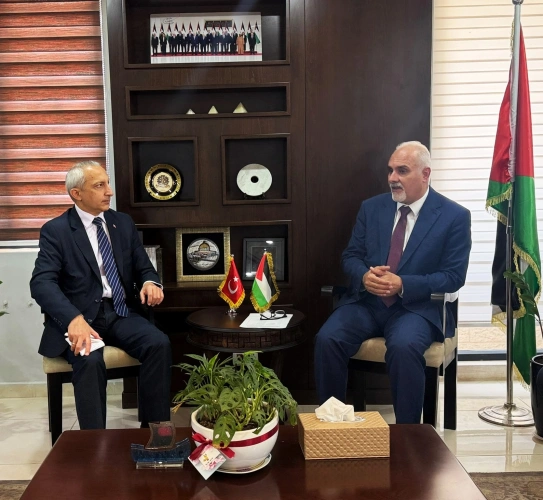
Palestinian Minister of Agriculture, Professor Rizq Slaimiya, met with the Ambassador of the Republic of Turkey to the State of Palestine, İsmail Çobanoğlu, to discuss ways to strengthen and expand the Palestinian-Turkish agricultural partnership. The meeting, held at the Minister’s office in Ramallah—and attended by Deputy Minister Bader Al-Hawamdeh and the Director General of International Relations and Media, Mahmoud Fatafta—focused on developing cooperation in agricultural development, knowledge and technology transfer, capacity building, scientific research, and agricultural trade.
At the beginning of the meeting, Slaimiya received a letter from the Turkish Minister of Agriculture and Forestry, delivered by the Ambassador, which included an action plan for bilateral agricultural cooperation for 2027. The plan emphasizes the exchange of knowledge and expertise, the transfer of modern agricultural technologies, and agricultural innovation. Both sides also discussed activating the memorandum of understanding signed between the two ministries—including the memorandum on cooperation in the forestry sector—with the aim of translating these agreements into concrete programs and projects, such as the management of forest resources, the protection of vegetation cover, and land rehabilitation.
Slaimiya briefed the Turkish Ambassador on the current state of the Palestinian agricultural sector, its strategic priorities, and the challenges on the ground—as well as the impact of these challenges on production, food security, and the livelihoods of farmers. He outlined the plans of the government and the Ministry regarding agricultural development, relief, recovery, and rehabilitation across both the southern and northern governorates. He emphasized that the Ministry is working to bolster the resilience of farmers, protect agricultural land and resources, restore productive capacities, and transition gradually from emergency response toward recovery and sustainable development.
The Minister stressed that supporting Jerusalem and strengthening the resilience of its agricultural sector is a core priority. This involves providing support to small-scale farmers and livestock breeders, developing tree-based horticulture, and enhancing the ability of farming families to sustain production and maintain their connection to their land and agricultural resources.
Regarding the livestock sector, Slaimiya highlighted the importance of expanding cooperation with the Turkish side to improve breeds and genetic programs, increase productivity, and facilitate the exchange of expertise and modern techniques in animal husbandry and genetic improvement. He also underscored the need to broaden collaboration in agricultural education and vocational and technical training. This includes strengthening academic ties between universities and educational institutions in both countries, as well as facilitating the exchange of experts, professors, and researchers—all of which will contribute to developing professional competencies and aligning education with the needs of the agricultural sector and the labor market. Regarding scientific research and innovation, the Minister emphasized the importance of developing partnerships between the Palestinian Agricultural Research Center and Turkish agricultural research centers and institutions. He highlighted the need to expand cooperation in applied research and technology transfer, with a focus on improving plant varieties, animal breeds, and field crops, as well as advancing animal production, sustainable agriculture, climate change adaptation, and resource scarcity management. He also underscored the value of leveraging Turkish expertise—including that of the CIMMYT center—to develop joint research programs that address Palestinian agricultural priorities.
On the economic and commercial front, the Turkish Ambassador noted his country’s interest in increasing the share of Palestinian dates in the Turkish market to approximately 10,000 tons. This would provide an opportunity to boost exports and support farmers and producers. Furthermore, he discussed the potential to utilize Turkey’s strategic location, trade relations, and logistics networks to facilitate the access of Palestinian dates and agricultural products to markets in Central Asian countries.
The Ambassador affirmed that Turkish projects and interventions in the agricultural sector are aimed at enhancing employment opportunities and livelihoods, improving income sources for agricultural communities, supporting production, building capacity, and transferring expertise and technology. He expressed his country’s commitment to transforming these potential areas of cooperation into concrete joint programs and projects.
Slaimiya commended the efforts of the Turkish Cooperation and Coordination Agency (TIKA) in Palestine, acknowledging the support, projects, and initiatives it has provided. He stressed the importance of TIKA continuing its role in supporting small-scale farmers, building capacity, facilitating the transfer of knowledge and technology, and strengthening the resilience of agricultural communities. He also commended Turkey’s supportive stance toward Palestine, as well as the efforts of Ambassador Çobanoğlu in strengthening communication and coordination between Palestinian and Turkish institutions.
The two sides agreed to continue coordinating on the development of an agricultural cooperation plan for 2027, translating it into actionable programs. These initiatives will encompass the exchange of expertise, scientific research, agricultural education and training, livestock development, breed improvement, forestry, and the adoption of modern technologies. Furthermore, the plan includes supporting Jerusalem and its farmers, enhancing agricultural trade, and opening new markets for Palestinian products.