Notification
حظر استيراد كافة أنواع الطيور الحية الداجنة والبرية وطيور الزينة وبيض التفقيس والصيصان عمر يوم ومخلفاتها الغير معاملة حراريا من تركيا ولحين استقرار الوضع الصحي

Nablus: April 14, 2026
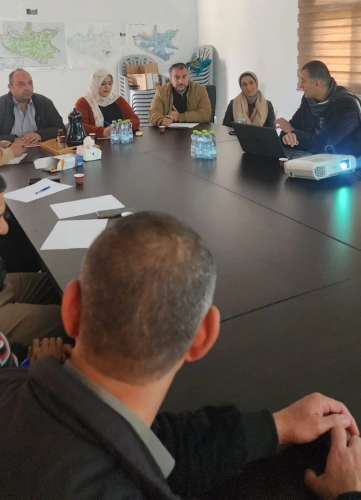
In a significant step towards enhancing the sustainable management of water resources, the General Directorate of Agricultural Water and Irrigation at the Ministry of Agriculture held an important coordination meeting. Representatives from the General Directorate, the Directorates of Agriculture in Nablus and Tulkarm, the Wadi al-Sha'ir Association, and Nablus Municipality participated in the meeting, which aimed to present and discuss the Sanitation Safety Plan (SSP) related to the reuse of treated wastewater for agricultural irrigation.
This meeting is part of the activity to develop the Sanitation Safety Plan within the framework of the project supporting the implementation of the Regional Initiative on Water Scarcity in the Near East and North Africa. The initiative is being implemented in partnership with the Palestinian Water Authority and the Environment Quality Authority, and is funded by the Food and Agriculture Organization (FAO). This initiative promotes institutional integration and achieves the safe and sustainable management of treated wastewater use.
During the meeting, a representative from the General Directorate of Agricultural Water and Irrigation presented a detailed overview of the main pillars of the Safety Plan. These include identifying potential risks associated with the use of treated wastewater, establishing control and administrative procedures to mitigate these risks, and implementing monitoring and verification mechanisms to ensure compliance with approved standards. The importance of coordination among partners to ensure the effective implementation of the plan was also emphasized, along with raising farmers' awareness of safe irrigation practices to protect public health and the environment and achieve optimal use of available water resources.
Participants affirmed that these joint efforts represent a strategic step towards expanding the use of treated wastewater in the agricultural sector, particularly in light of the growing challenges associated with water scarcity and climate change, thus contributing to supporting the resilience of the agricultural sector and enhancing food security.