Notification
حظر استيراد كافة أنواع الطيور الحية الداجنة والبرية وطيور الزينة وبيض التفقيس والصيصان عمر يوم ومخلفاتها الغير معاملة حراريا من تركيا ولحين استقرار الوضع الصحي

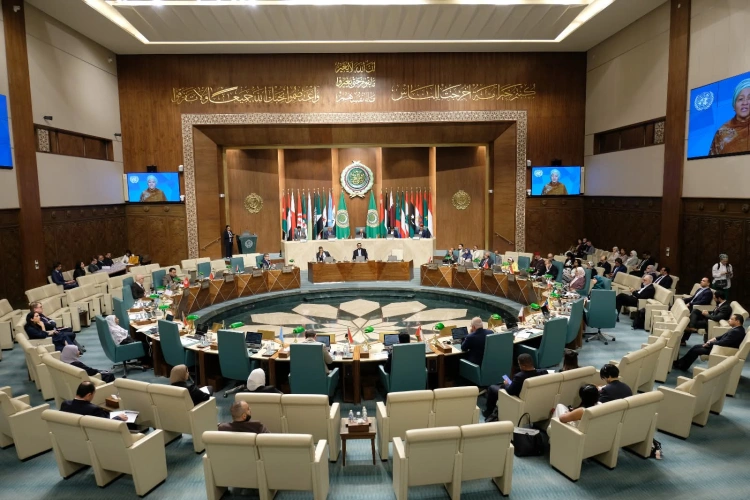
Cairo, May 6, 2026
Minister of Agriculture Riziq Slaimiya called for the urgent need to support the agricultural sector in Palestine, emphasizing its crucial role as a social and economic pillar, especially given the recent loss of income for thousands of families.
In his address to the Fourth Meeting on the Transformation of Food Systems in the Arab Region, which commenced today at the General Secretariat headquarters, Minister Slaimiya, along with the Director General of International Relations and Media at the Ministry, Eng. Mahmoud Fatafta, and Third Secretary Ola Amer from the Palestinian Mission to the League of Arab States, stated that Palestine faces a highly complex food and agricultural reality. Agriculture is no longer merely a productive sector, but has become a cornerstone of resilience, a means of protecting the land, and a way to preserve livelihoods.
He also stressed the need, in light of geopolitical changes and the escalation of wars and conflicts, for a strategic agricultural and production approach, prioritizing needs and formulating effective, efficient, and sustainable interventions focused on food security, agricultural empowerment, and participation in the production process. Agriculture, he emphasized, is essential for life and survival.
He pointed to the necessity of increasing agricultural budgets in Arab governments to enable them to strengthen productive sectors, protect farmers and their lands, and enhance food security. He further emphasized the need to increase contributions and subscriptions from international organizations working in the agricultural sector. He stated that in Palestine, we need not only food aid but also empowerment to enable our people to produce their own food, protect their land, create decent job opportunities, and preserve their dignity.
The Minister of Agriculture called upon our partners to support a practical and balanced response that combines immediate relief, recovery, and long-term investment in a more resilient, equitable, and sustainable Palestinian food system. He stressed the importance of clearly prioritizing support for young women and men, expanding agricultural innovation, entrepreneurship, and modern technologies that make agriculture more capable of creating jobs, increasing production, and addressing crises.
As he explained, the latest humanitarian estimates indicate that approximately 3.6 million Palestinians are in need of assistance and protection, including about 2.1 million in the Gaza Strip and 1.5 million in the West Bank, including East Jerusalem. He noted that these figures reflect not only food needs but also a broader crisis affecting income, employment, access to services, and resilience to shocks, placing direct pressure on food systems and the agricultural sector to continue as a source of food and livelihoods.
In his address, Minister Slaimiya stated that the latest Integrated Food Security Phase Classification (IPC) results for the Gaza Strip show that the recent relative improvement resulting from a decrease in the intensity of the conflict and improved access to humanitarian aid and commercial food flows does not mean the crisis is over. Approximately 1.6 million people are facing high levels of acute food insecurity, classified as crisis or worse. This underscores that the improvement remains fragile and depends on continued humanitarian and commercial access, as well as the restoration of a minimum level of local productive capacity.
He stated that the available figures reveal the extent of the damage inflicted on the agricultural production base, agricultural assets, and agricultural infrastructure. In the West Bank, including East Jerusalem, the challenges take a different form but are no less serious. Restrictions on movement, checkpoints, land confiscation, limited access to water, agricultural land, and grazing areas, settler violence, and high input costs all hinder the ability of farmers and livestock breeders to continue production, leading to a doubling of food insecurity in the West Bank and East Jerusalem.
He added that these obstacles come amidst high unemployment rates, loss of income sources, and declining purchasing power, increasing the need for a greater role for the agricultural sector in providing food, employment opportunities, and income, especially for rural and vulnerable families. Today's needs are not limited to providing food, although that remains an urgent humanitarian priority, but also include protecting the Palestinian people's ability to produce their own food. This requires a balanced response that supports immediate relief, rebuilds livelihoods, protects productive assets, provides feed, seeds, and agricultural inputs, rehabilitates irrigation networks and wells, strengthens veterinary and extension services, and develops local value chains, including post-harvest operations, storage, marketing, and food processing.
Slaimiya stated that the Ministry of Agriculture works to protect local production as the first line of defense for food security, rehabilitate damaged agricultural assets, support small farmers and livestock breeders, promote climate-smart agriculture, improve water and natural resource management, and empower women and youth to work and produce within the agricultural and food economy.
Ambassador Ali Al-Maliki, Head of the Economic Affairs Sector at the League of Arab States, warned of the serious repercussions of the current regional situation and the tensions of the US-Iranian conflict, including the potential disruption to maritime navigation and the possible closure of the Strait of Hormuz.
Al-Maliki explained that the Gulf states are among the world's largest producers of fertilizers, noting that any disruption to the flow of supplies through the Strait would have a direct impact on global food security, given the international markets' reliance on these strategic commodities.
It is worth noting that the meeting, organized by the Economic Affairs Sector of the League of Arab States in cooperation and partnership with the UN Food Systems Coordination Centre, the Food and Agriculture Organization of the United Nations (FAO), and the United Nations Economic and Social Commission for Western Asia (ESCWA), and with the participation of regional offices of several UN agencies, including the United Nations Development Programme (UNDP), the World Health Organization (WHO), the World Food Programme (WFP), and the International Fund for Agricultural Development (IFAD), aimed to formulate a regional vision for enhancing food security and addressing the challenges of food insecurity.