Notification
حظر استيراد كافة أنواع الطيور الحية الداجنة والبرية وطيور الزينة وبيض التفقيس والصيصان عمر يوم ومخلفاتها الغير معاملة حراريا من تركيا ولحين استقرار الوضع الصحي

Jericho and Jordan Valley Governorate extends over an area of 592 square kilometers, with a length of 50 km and a width ranging from 7 to 15 km depending on the location. The area of the areas called (C) is 523 square kilometers, 8.88% of which is pastoral land. Our farmers and livestock breeders are deprived of grazing their sheep due to settlement, which constitutes the main obstacle to preventing the creation of sustainable development in Palestine, especially in the Jericho Governorate. And the valleys. While the areas under the Palestinian National Authority are estimated at 68 square kilometers, which is approximately 10.2% of the total area of the governorate, thus taking over all forms of survival.
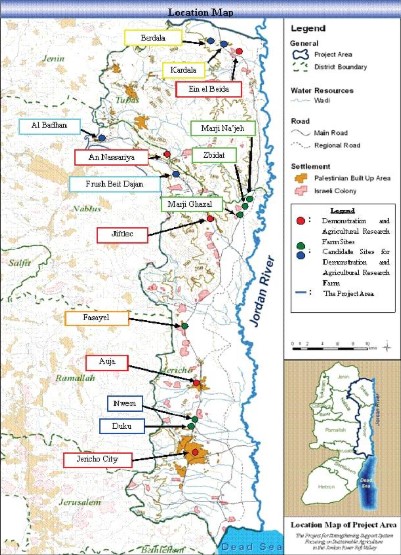
Israel appropriates approximately 95% of Palestinian water resources in the governorate from the Jordan River and Lake Tiberias, exploiting this water for illegal settlement activities that systematically work to uproot Palestinians from their land—either directly or through replacement policies implemented by the occupation. These policies include control over land, water, and natural resources, and the forcible prevention of farmers from carrying out agricultural activities. Through these measures, the occupation seeks to enforce forced displacement of Palestinians from their land.
Agriculture is the primary economic sector in the governorate, with the majority of the population depending on it. The cultivated agricultural area in Jericho and Al-Aghwar is approximately 50,000 dunums out of 500,000 dunums suitable for agriculture. This includes:
30,000 dunums of Medjool date palms
2,500 dunums of other fruit orchards
17,000 dunums of diversified fresh vegetables
The livestock population in the governorate is estimated at approximately:
80,000 heads of sheep and goats
2,000 heads of cattle
Livestock farming is concentrated in Bedouin communities and Area C. Jericho and Al-Aghwar is also a major poultry producer, generating:
Over 4 million broiler chickens
Approximately 40,000 laying hens for table egg production
The agricultural sector employs approximately 20,000 workers, both permanently and seasonally, most of whom come from other governorates. Permanent employment is concentrated in the date sector, particularly in packing houses, of which there are 22 date-producing and exporting companies.
Women’s labor is concentrated in date packing houses, with approximately 3,500 women workers engaged mainly in quality-related activities such as sorting, grading, packaging, and labeling.
There are 25 Bedouin communities in Jericho and Al-Aghwar Governorate, all located in Area C, relying primarily on grazing as their main livelihood and subsisting largely on livestock production.
These communities own approximately 80,000 heads of sheep and goats, primarily local breeds that are genetically adapted to the climate and environment—especially their ability to graze in rugged rangelands across Jericho and Al-Aghwar, the eastern slopes, and the eastern Jerusalem desert.
These communities are distributed throughout the governorate, including:
Marj Na’ja, Al-Jiftlik, Fasayil, Al-Auja, Al-Dyouk, An-Nuway’ima, Al-Ma‘arajat, the Construction Project area, As-Sih, outskirts of Aqbat Jaber Refugee Camp, Al-Marshahat, Wadi Qelt, Nabi Musa, Al-Khan Al-Ahmar, Al-Hathroura, and others.
| Area | Date Palms | Grapes | Bananas | Vegetables | Maize & Field Crops |
|---|---|---|---|---|---|
| Marj Al-Ghazal / Marj Na’ja / Az-Zubaidat | 2,260 | 5 | 0 | 950 | 500 |
| Al-Jiftlik | 7,235 | 88 | 0 | 4,000 | 200 |
| Fasayil | 348 | 0 | 0 | 650 | 0 |
| Al-Auja | 4,270 | 32 | 700 | 4,000 | 800 |
| Jericho | 15,300 | 5 | 1,300 | 7,000 | 80 |
| Total | 29,413 | 130 | 2,000 | 16,600 | 1,580 |
Earthen ponds
Metal ponds
Artesian wells
(Data reflects varying numbers, storage capacities, and operational outputs ranging from 60–120 m³/hour, depending on location.)
Jericho and Al-Aghwar produces approximately:
25,000 tons of high-quality Medjool dates, with an expected export of 18,000 tons during the 2025–2026 season, valued at USD 150 million, exported directly to 37 countries and indirectly to 62 countries worldwide.
40,000 tons of diversified vegetables, primarily during winter and spring (October–May).
Over 10,000 tons of early-season watermelon (April).
Approximately 16,000 tons of bananas, produced between October and June, with peak production from October to March.
4 million broiler chickens, producing approximately 5,200 tons of white meat annually.
More than 8 million table eggs per year.
The governorate has more than 5,000 agricultural holders, including:
1,600 livestock production holdings
900 date palm holdings
2,500 plant production holdings (vegetables and non-date fruit orchards)
Promising agricultural investment opportunities exist in relatively secure Area C locations adjacent to Palestinian rural communities. These lands are estimated at 20,000 dunums that could be cultivated if investment were available.
If developed, these lands could generate approximately 8,000 decent job opportunities.
| Area | Potential Cultivation Area (Dunums) |
|---|---|
| Jericho | 3,500 |
| Al-Auja | 6,000 |
| Al-Jiftlik | 6,000 |
| Fasayil | 3,500 |
| Marj Al-Ghazal / Marj Na’ja / Az-Zubaidat | 1,000 |
| Total | 20,000 |
Occupation practices aimed at annexing the Jordan Valley—through planning and implementation, including annexation plans and the so-called “Deal of the Century”—are systematic efforts to eliminate the viability of the two-state solution through coercive policies designed to forcibly displace Palestinians.
Israeli forces protect settler groups and grant them unchecked authority to perpetrate organized violence against Palestinians, including the destruction of agricultural infrastructure and armed intimidation by settlers trained in specialized military camps. These actions amount to ethnic cleansing in the Jordan Valley, generating widespread fear and insecurity.
Closure policies, combined with settlement expansion, aim to end Palestinian presence in the Jordan Valley and impose full control over Palestine’s only gateway to the outside world, thereby isolating Palestinians economically and morally from the international community and their Arab depth.
Between 2022 and 2025, direct agricultural sector damages are estimated at approximately USD 35 million, including:
Demolition of agricultural structures
Killing and theft of livestock
Destruction of water pipelines
Destruction of earthen ponds
Denial of grazing access
Indirect losses include agricultural product spoilage and increased production costs caused by Israeli checkpoints that restrict the movement of goods and inputs, resulting in severe losses to the agricultural sector—the main livelihood source in the governorate.
The main challenges include:
Settlement-based pastoral expansion and settler militias (“Hilltop Youth”) seizing rangelands, preventing Palestinian grazing, and terrorizing herders and children.
Environmental protection programs imposed by the Israeli Civil Administration, declaring eastern slopes as “nature reserves,” banning grazing and access to natural springs, and polluting water sources in Wadi Qelt and Ein Mikhamas with wastewater.
Ongoing confiscation, demolition, and forced displacement of Bedouin property, livestock shelters, water tanks, and agricultural equipment.
Israeli police harassment of tractors used to transport water due to licensing restrictions and vehicle deterioration.
High costs of animal feed and veterinary services, increased disease outbreaks, and lack of a local veterinary laboratory.
Low twinning rates and high mortality among newborn livestock due to economic fragility and lack of genetic improvement programs.
Lack of basic services such as electricity and water, insufficient water storage capacity, outdated agricultural machinery, and restrictions on vehicle licensing and road access—especially along Route 90.